AI visibility readiness is the first-mile audit that checks whether AI answer engines can crawl, understand, verify, and cite a brand before a team starts tracking real model answers. It is not a replacement for AI visibility measurement. It is the foundation that makes measurement useful.
This matters because brand discovery is no longer limited to a search results page. Buyers ask ChatGPT, Perplexity, Gemini, Claude, Grok, Google AI Overviews, and other AI search experiences to compare tools, shortlist vendors, validate claims, and explain what a company does. If a brand cannot be accessed, parsed, or verified, it has a weaker chance of being mentioned when those answers are generated.
This guide gives you a practical GEO checklist you can run before investing in full AI visibility tracking. It also explains how to use the open-source OranGEO AI Visibility Skill as a free readiness audit, and when to move from readiness diagnosis to measured visibility inside OranGEO.
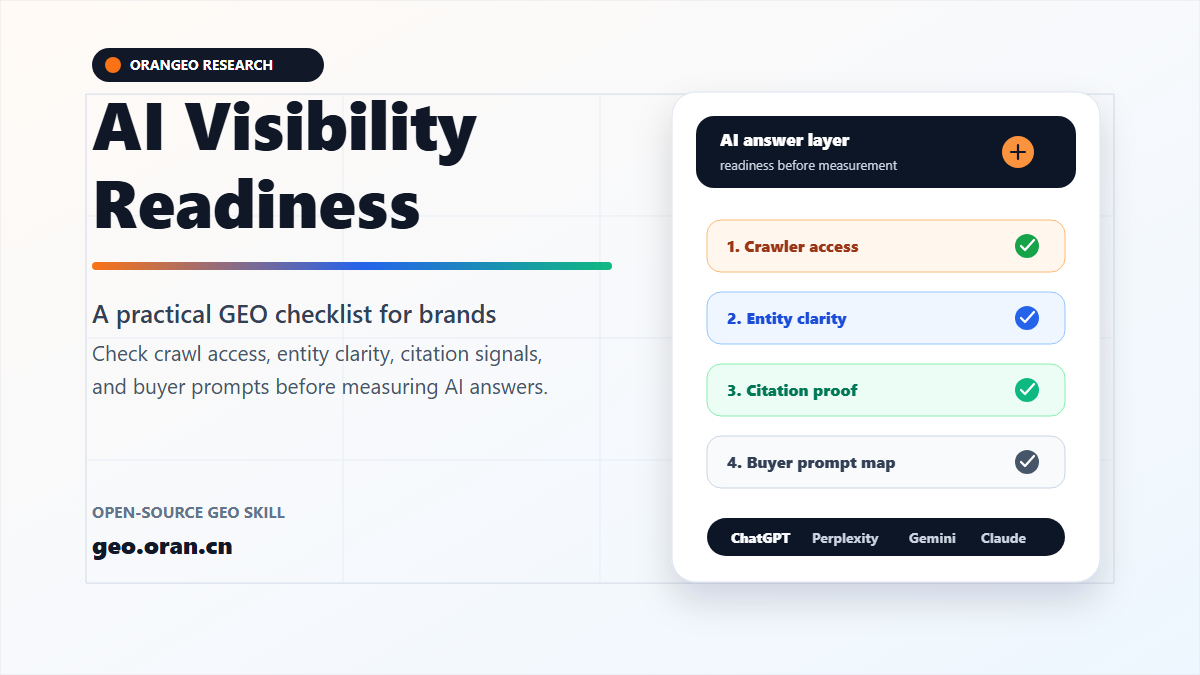
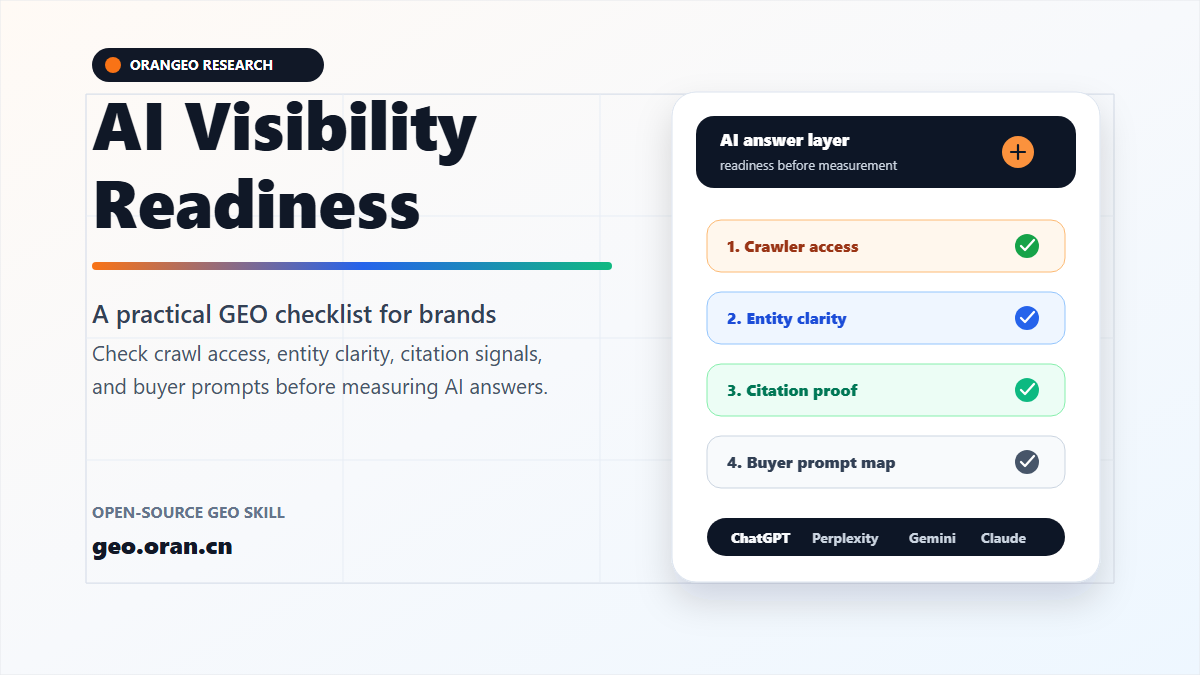
The AI Visibility Readiness Checklist
- Allow the right crawlers: Check whether robots.txt allows search and retrieval bots such as OAI-SearchBot, Claude-SearchBot, PerplexityBot, Googlebot, and other relevant user agents.
- Make key pages discoverable: Ensure important product, pricing, docs, comparison, FAQ, and proof pages are linked, canonical, indexed, and present in sitemap.xml.
- Publish a useful llms.txt: Add a concise, curated Markdown guide at /llms.txt that points AI systems and agents to your most important pages.
- Use clear metadata and schema: Titles, descriptions, headings, Open Graph tags, Article or Organization schema, and visible page copy should tell the same story.
- Create citation-ready content: AI systems need specific facts, evidence, definitions, comparisons, pricing clarity, docs, and third-party proof.
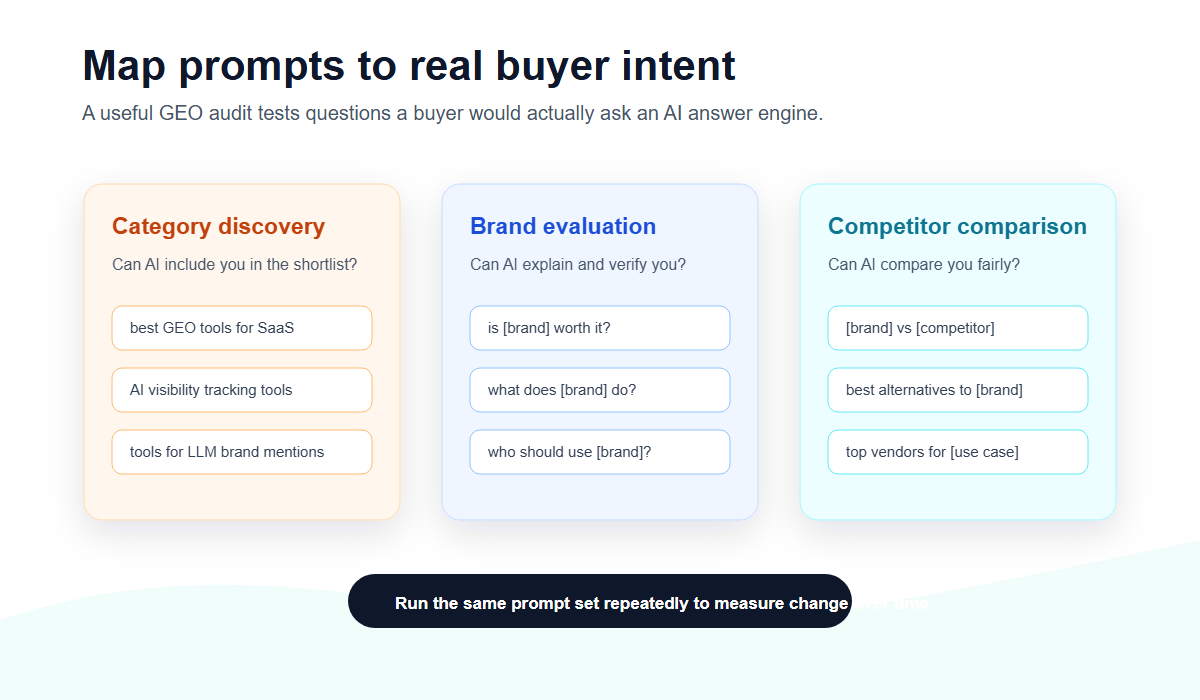
- Map buyer prompts: Test category discovery, brand evaluation, and competitor comparison prompts instead of random vanity questions.
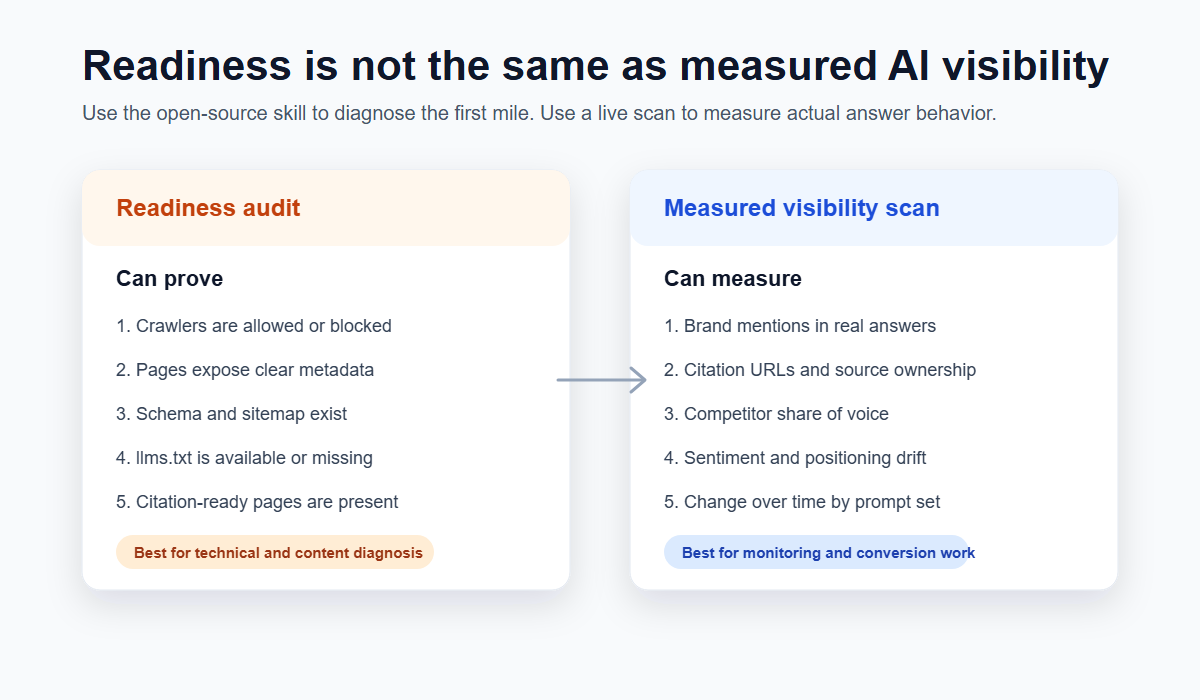
- Measure after readiness: A readiness score shows whether your site is prepared. A live AI visibility scan shows whether models actually mention, cite, and recommend you.
What Is AI Visibility Readiness?
AI visibility readiness is a structured review of the signals that make a brand usable by AI answer engines. The goal is to answer four questions:
- Can AI systems access the content? This includes robots.txt, CDN and WAF rules, server responses, sitemap discovery, and JavaScript rendering risk.
- Can AI systems understand the brand? This includes clear titles, headings, entity names, category language, product descriptions, and page structure.
- Can AI systems verify the claims? This includes schema, documentation, pricing, case studies, review profiles, press mentions, comparison pages, and third-party citations.
- Can the team measure real answer behavior? This requires a repeatable buyer prompt set and a way to track mentions, citations, competitors, and sentiment across engines.
The distinction is important. A readiness audit can tell you that your website is prepared to be discovered and cited. It cannot prove that ChatGPT, Perplexity, Gemini, Claude, or Grok will recommend you in a live answer. For that, you need controlled prompt testing across models and time.
Why Readiness Comes Before Measurement
GEO, or generative engine optimization, was formalized as a way to improve content visibility in generative engine responses. The Princeton-led GEO paper presented at KDD 2024 describes generative engines as systems that synthesize information from multiple sources and introduces methods for measuring and improving visibility in those answers.
In practice, this means teams need two layers of work. First, make the brand accessible, understandable, and credible. Second, measure whether the brand appears in real generated answers. Skipping the first layer creates noisy measurement. If a model does not mention your brand, you will not know whether the issue is crawl access, unclear positioning, missing proof, weak source authority, or simple model preference.
Google's own documentation on AI features and websites also reinforces the foundation: AI Overviews and AI Mode still rely on core Search requirements such as crawlability, indexability, useful content, internal links, visible textual content, and structured data that matches the page. In other words, GEO does not erase SEO. It adds a measurement and answer-citation layer on top of it.
The 7-Layer AI Visibility Readiness Checklist
1. Robots.txt and AI Crawler Access
Start with robots.txt. Many brands block bots accidentally through old SEO rules, WAF defaults, CDN filters, or broad disallow patterns. That matters more now because different AI systems use different crawlers for different purposes.
OpenAI's crawler documentation separates OAI-SearchBot, GPTBot, and ChatGPT-User. OAI-SearchBot is tied to search visibility in ChatGPT search features, while GPTBot is associated with model training controls. Anthropic documents ClaudeBot, Claude-User, and Claude-SearchBot, each with a different purpose. Perplexity documents PerplexityBot and Perplexity-User, with PerplexityBot used to surface and link websites in search results.
The practical rule is simple: do not treat all AI crawlers as the same. A brand may choose to block training crawlers while allowing search and retrieval crawlers. The readiness question is whether your robots.txt reflects that strategy intentionally.
| Check | Why it matters | Fix if weak |
|---|---|---|
| Search crawler access | AI search systems need permission to index or retrieve public pages. | Review rules for OAI-SearchBot, Claude-SearchBot, PerplexityBot, Googlebot, and Bingbot. |
| Training crawler policy | Training access and search visibility are not always the same control. | Separate search/retrieval rules from training rules such as GPTBot or ClaudeBot. |
| WAF and CDN behavior | A clean robots.txt file is not enough if infrastructure blocks the request. | Check logs and allow documented bots where appropriate. |
2. Sitemap, Internal Links, and Canonicals
AI search still depends on discoverable pages. A sitemap helps engines find pages, but internal links help them understand importance and relationships. For GEO, the highest-value pages are often not generic blog posts. They are the pages that answer buyer questions: product overview, pricing, documentation, feature pages, comparison pages, alternatives pages, security pages, FAQ pages, case studies, benchmarks, and methodology pages.
Your readiness audit should identify whether those pages exist, whether they return a 200 status, whether they are canonical, whether they appear in sitemap.xml, and whether they are reachable through normal site navigation. If a critical product page only exists behind a client-side route or is buried with no internal links, AI systems may have a weaker path to use it as evidence.
3. llms.txt as a Curated AI Guide
The llms.txt proposal recommends a Markdown file at /llms.txt that gives language models and agents a concise guide to a website. It is not a universal ranking standard, and Google says no new AI-specific text file is required for AI Overviews or AI Mode. Still, llms.txt is useful for a different reason: it forces a brand to curate the pages it most wants AI systems, agents, and developers to understand.
A good llms.txt should be short, factual, and selective. Include the brand summary, product category, ideal users, key docs, pricing or plan pages, case studies, comparison pages, and API or developer resources if relevant. Do not turn it into a keyword dump. Treat it like a front door for machine readers.
4. Metadata, Headings, and Structured Data
AI systems need clarity before they can cite. Every important page should have a clear title, meta description, H1, canonical URL, and visible explanation of what the page is about. Open Graph tags help social and preview systems, while schema markup helps search engines understand page entities and article metadata. Google's Article structured data documentation explains how article markup can help Google understand title, image, and date information for article pages.
The key is consistency. If a title says one thing, the H1 says another, schema says a third thing, and the visible copy hides the actual product category, AI systems have to infer too much. Strong GEO pages reduce that uncertainty.
5. Citation-Ready Content
Many pages are readable by humans but weak as AI sources. A model needs concise, standalone passages it can quote, summarize, or use as evidence. Citation-ready content usually has these traits:
- Definitions written in plain language.
- Specific product facts, not only claims.
- Comparison tables that explain tradeoffs fairly.
- FAQ blocks that answer natural-language buyer questions.
- Pricing, plan, security, methodology, and documentation pages that reduce ambiguity.
- Evidence such as case studies, benchmarks, reviews, integrations, customer examples, or original research.
This is where classic marketing copy often fails. "The leading platform for growth" is not citation-ready. "OranGEO measures brand mentions, citations, competitor co-mentions, sentiment, and source distribution across AI answer engines" is much easier for a model to reuse accurately.
6. Third-Party Source Signals
Your website is necessary, but it is not the whole answer graph. AI systems often draw on third-party sources: review platforms, GitHub repositories, documentation hubs, media mentions, industry directories, YouTube, Reddit, partner pages, comparison articles, and public datasets. If competitors are present in those places and your brand is absent, a model may learn the category through someone else's framing.
This is why open-source distribution can be strategically useful when the project has real value. A GitHub repo gives developers a concrete artifact to inspect, star, fork, and cite. For OranGEO, the open-source skill is not just a lead magnet. It is a public reference implementation of the first-mile GEO audit.
7. Buyer Prompt Coverage
Finally, build a prompt set that mirrors real buyer behavior. Do not only ask, "What is my brand?" That tells you little about demand. Ask prompts that resemble discovery, evaluation, and comparison.
A useful starter set has 15 prompts: seven category discovery prompts, five brand evaluation prompts, and three competitor comparison prompts. This creates enough coverage to reveal whether the brand is included in the shortlist, whether AI systems describe it accurately, and whether competitors dominate the answer.
How to Run a Free First-Mile Audit
We open-sourced the OranGEO AI Visibility Skill so teams can run this readiness workflow without creating an account or using an API key. The script checks public signals such as robots.txt, llms.txt, sitemap.xml, metadata, schema, citation pages, comparison signals, and buyer prompts.
The open-source version gives you:
- A readiness score across AI access, technical clarity, citation readiness, and competitive coverage.
- Evidence for missing or weak signals.
- Recommended fixes that a marketing or engineering team can act on.
- A 15-prompt buyer set to test across ChatGPT, Gemini, Perplexity, Claude, Grok, and other AI systems.
- A starter llms.txt template when the site does not have one.
You can also use OranGEO's free tools if you prefer a web workflow: start with the AI Visibility Checker, generate a curated file with the llms.txt Generator, and build test questions with the GEO Prompt Generator.
What Readiness Cannot Measure
A readiness audit does not show actual AI share of voice. It does not capture live citation URLs from model answers. It does not tell you whether a competitor appears more often than you, whether sentiment is improving, or whether a new piece of content changed model behavior over time.
That is where measured AI visibility starts. A full scan in OranGEO runs controlled prompts across AI answer engines and tracks brand presence, citation ownership, competitor co-mentions, sentiment, source distribution, saved snapshots, and monitoring over time. Readiness tells you whether the site is prepared. Measurement tells you whether the market-facing answer layer is changing.
A Practical 30-Day GEO Workflow
Week 1: Diagnose the foundation
Run the readiness audit. Fix obvious crawler access, sitemap, metadata, schema, and llms.txt issues. Make sure important pages are reachable and have clear text in the initial HTML.
Week 2: Build the buyer prompt set
Create prompts for category discovery, brand evaluation, and competitor comparison. Save the exact wording so you can test the same set repeatedly. This is the measurement baseline.
Week 3: Repair citation gaps
Publish or improve the highest-impact pages: a category guide, comparison page, FAQ, pricing page, evidence page, or methodology page. Use direct answers, tables, proof points, and internal links. Link related pages from your docs, blog, and product pages.
Week 4: Run a measured scan
Measure real model answers. Track whether your brand appears, which sources are cited, which competitors appear, and how the answer describes you. If the team is ready to monitor ongoing movement, compare OranGEO pricing plans and choose the scan volume that matches your workflow.
FAQ
Is GEO different from SEO?
Yes, but it builds on SEO. SEO helps pages get crawled, indexed, ranked, and clicked. GEO focuses on whether AI answer engines can understand, mention, cite, and recommend a brand inside generated answers. Strong crawlability, useful content, structured data, and internal links still matter.
Does llms.txt guarantee AI visibility?
No. llms.txt is a useful proposal and a practical curation layer, but it does not guarantee inclusion in ChatGPT, Google AI Overviews, Perplexity, Claude, Gemini, or Grok. Treat it as one readiness signal, not a magic ranking file.
Should brands allow every AI crawler?
No. Brands should decide intentionally. Some crawlers are used for search or retrieval. Others are associated with training. A mature policy may allow search visibility while limiting training use. The important thing is to understand what each user agent does before blocking broadly.
What is the fastest way to start?
Run the open-source OranGEO AI Visibility Skill against your homepage, fix the highest-priority readiness issues, then run the same 15 buyer prompts in OranGEO to measure real answer visibility.
The Bottom Line
AI visibility readiness is the bridge between traditional SEO hygiene and real GEO measurement. It helps teams stop guessing and start diagnosing. Can AI systems access the site? Can they understand the brand? Can they verify the claims? Do we have prompts that match how buyers actually ask for recommendations?
The open-source skill gives teams a free way to answer those questions. OranGEO gives teams the next layer: measured AI visibility across models, citations, competitors, and time.
Start with the free readiness audit. When you need to know what AI systems actually say about your brand, run a full scan in OranGEO.