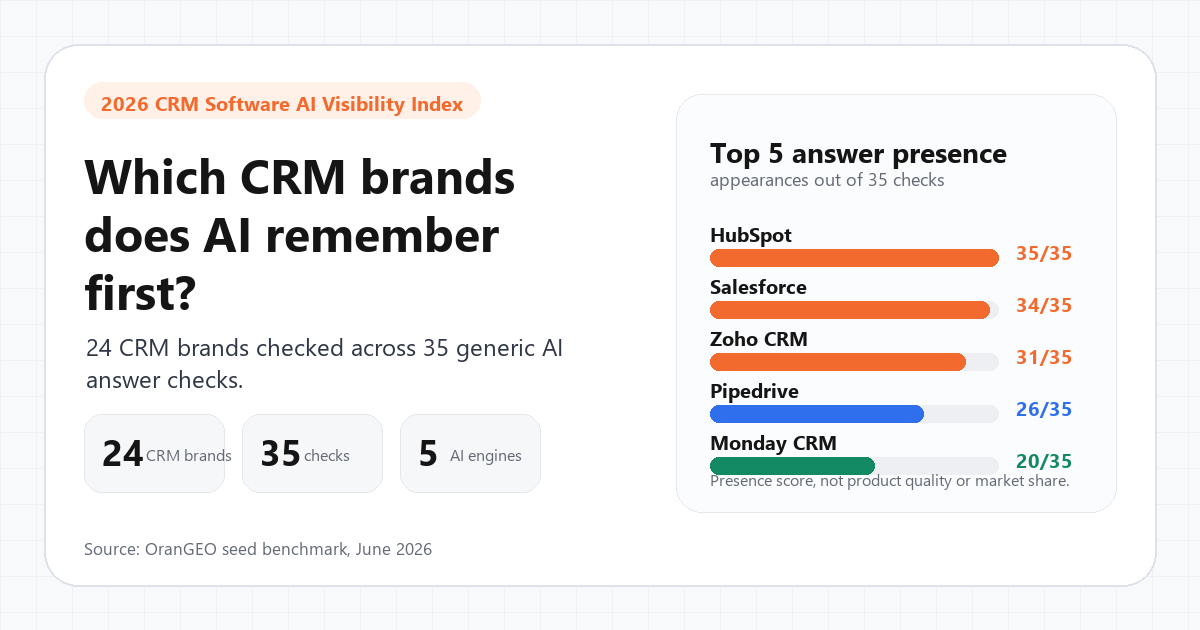
CRM software AI visibility measures whether a CRM brand appears when AI answer engines respond to generic buyer questions such as "best CRM software," "CRM for small business," or "sales automation software." In OranGEO's seed benchmark, visibility was highly concentrated: HubSpot appeared in all 35 generic answer checks, Salesforce appeared in 34, and several recognized CRM brands appeared in fewer than 12% of checks.
This is not a ranking of product quality, market share, or customer satisfaction. It is a snapshot of which CRM brands AI systems remember first when they build a buyer shortlist.
Quick Answer
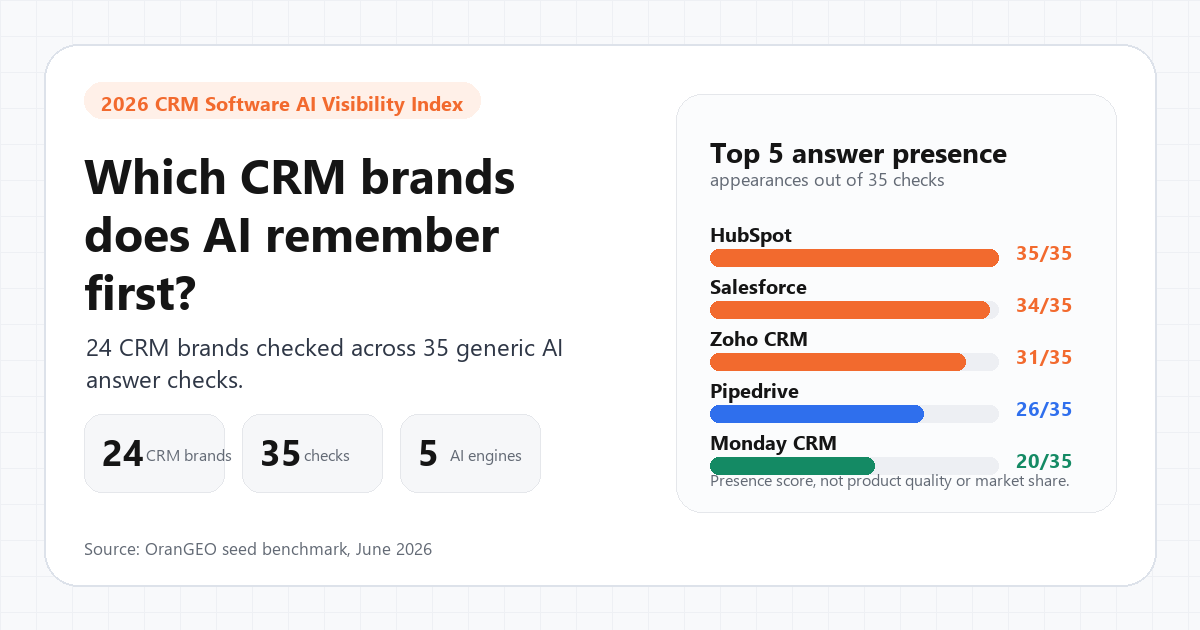
OranGEO checked 24 CRM brands across 35 generic AI answer checks using 7 buyer prompt themes and 5 AI answer engines: ChatGPT, DeepSeek, Gemini, Grok, and Perplexity. The top five CRM brands by answer presence were HubSpot, Salesforce, Zoho CRM, Pipedrive, and Monday CRM. The main finding is that AI recommendations compress a crowded CRM market into a small default shortlist.
Table Of Contents
- Key findings
- Top CRM brands by AI answer presence
- What the ranking shows
- Why AI visibility is a GEO problem
- Methodology
- How CRM brands can improve AI visibility
- SEO and GEO publishing notes
- FAQ
Key Findings
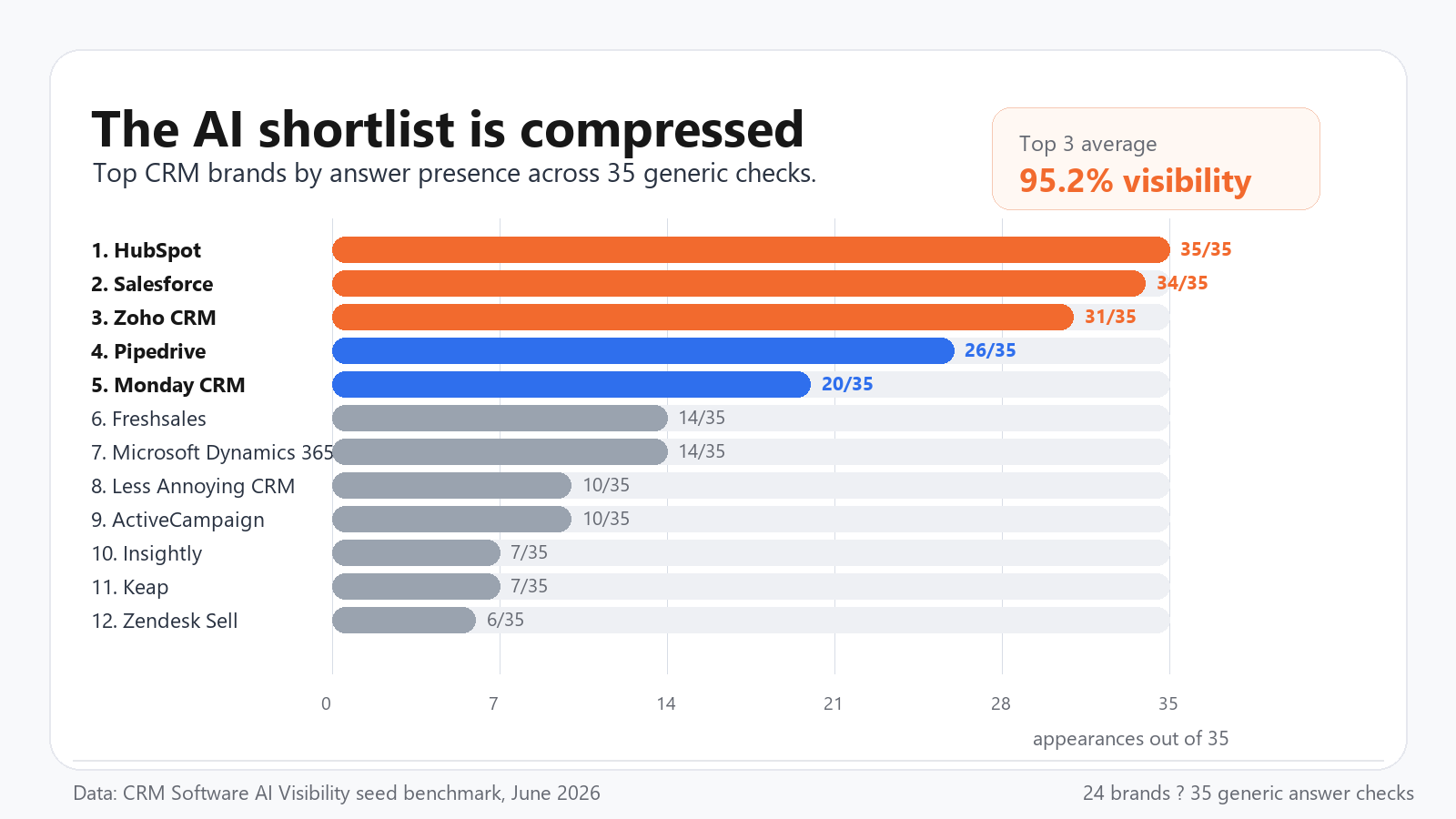
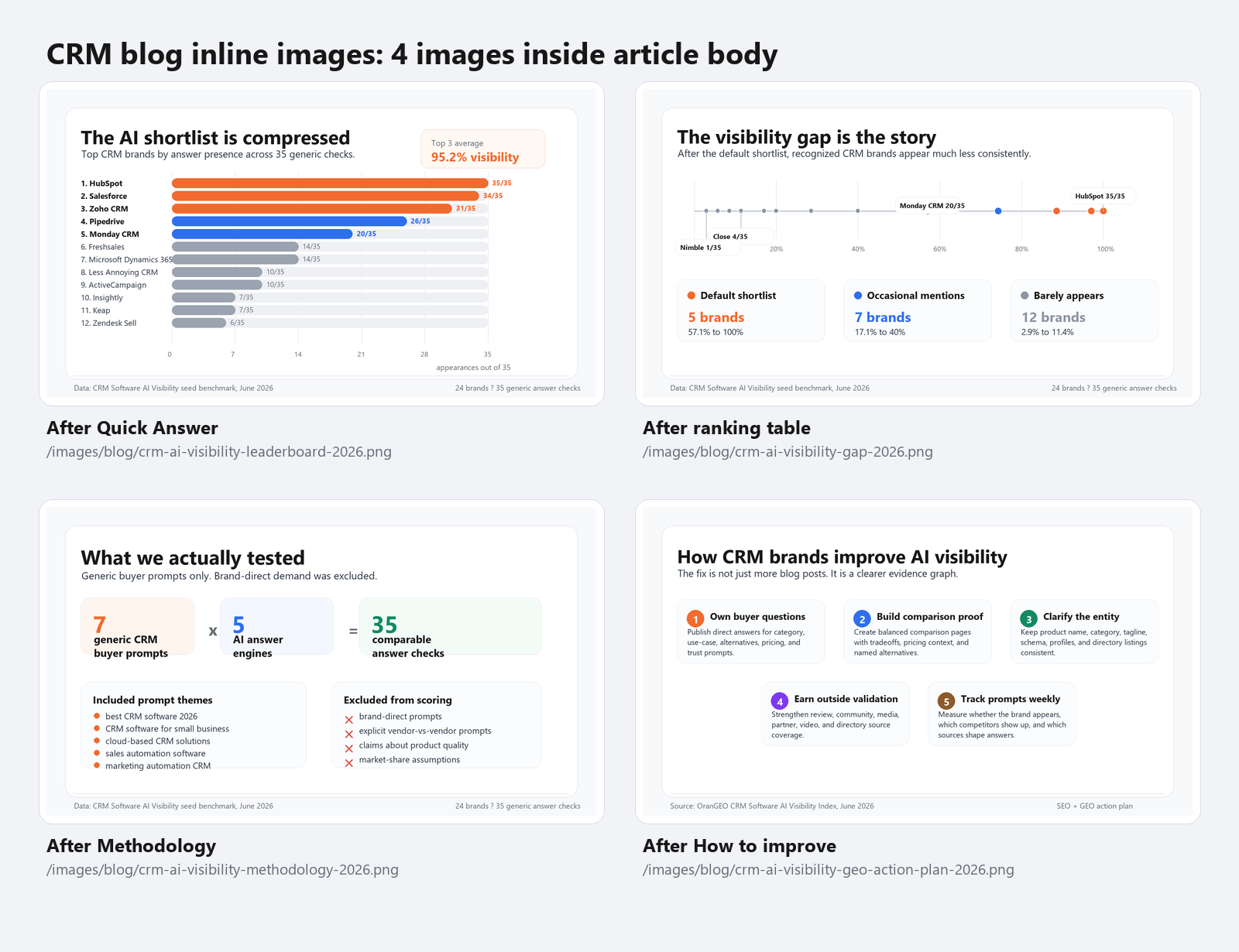
- The AI shortlist is compressed. The top 3 CRM brands averaged 95.2% answer presence across the 35 checks.
- HubSpot and Salesforce are the default AI recall set. HubSpot appeared in 35 of 35 checks, while Salesforce appeared in 34 of 35.
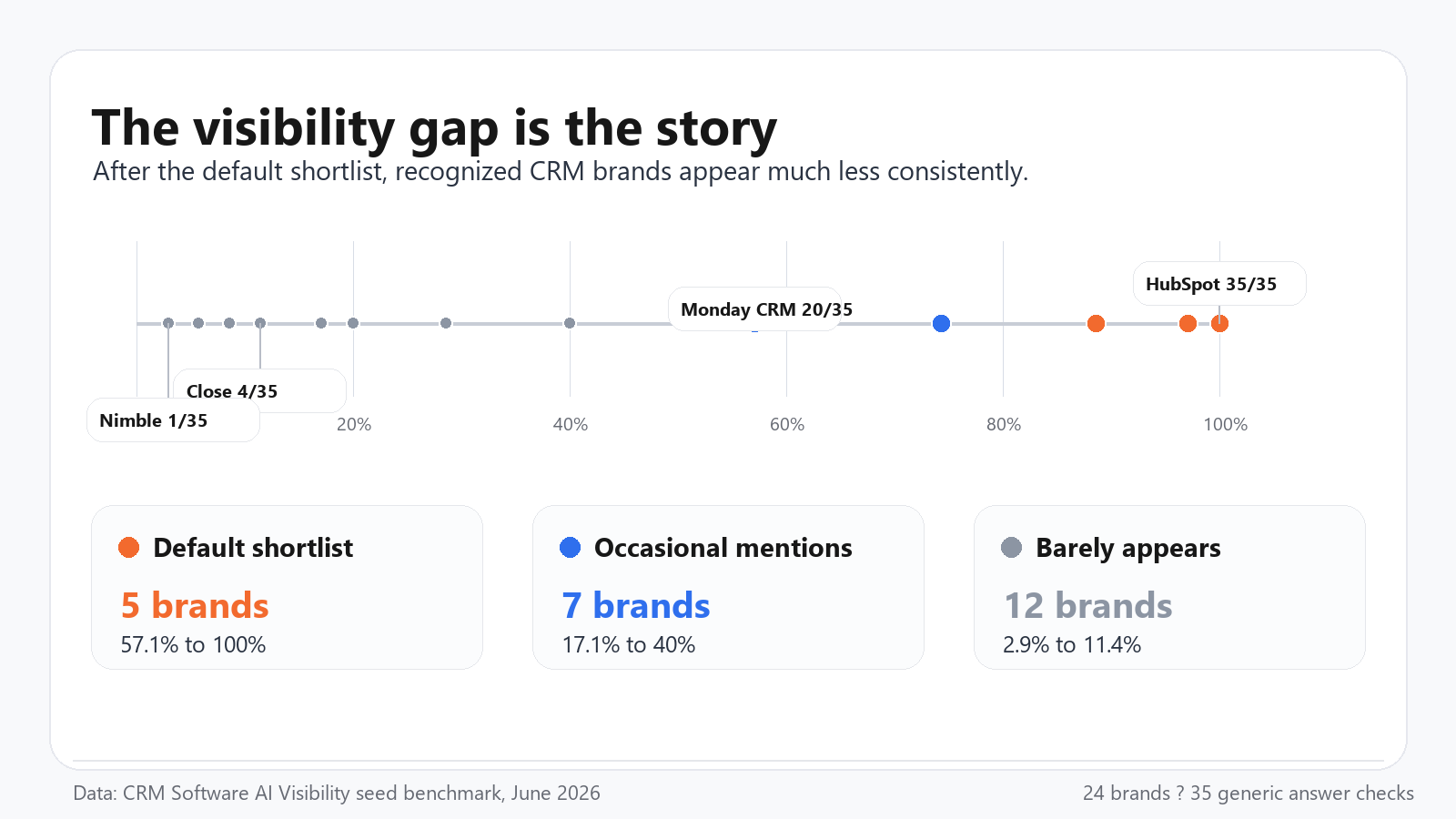
- Visibility drops sharply after the top five. Monday CRM ranked fifth at 20 of 35 checks, but the next group dropped to 14 of 35.
- Known brands can still be weak in AI answers. Close, Attio, Copper, Odoo CRM, Nimble, and other recognized CRM products appeared much less often in generic AI buying prompts.
- AI visibility is not only controlled by a brand's website. Vendor pages matter, but review sites, comparison articles, YouTube, Reddit, analyst-style pages, and integration directories also shape the answer graph.
For the live ranking and brand pages, see the full CRM Software AI Visibility Index.
Top CRM Brands By AI Answer Presence
The public score is based on answer presence across 35 generic CRM answer checks. If a brand appeared in 20 of 35 checks, its seed visibility score is 57.1%.
| Rank | CRM brand | Segment | Answer presence | Seed visibility score |
|---|---|---|---|---|
| 1 | HubSpot | CRM and marketing software | 35/35 | 100.0% |
| 2 | Salesforce | Enterprise CRM | 34/35 | 97.1% |
| 3 | Zoho CRM | CRM suite | 31/35 | 88.6% |
| 4 | Pipedrive | Sales pipeline CRM | 26/35 | 74.3% |
| 5 | Monday CRM | Workflow-based CRM | 20/35 | 57.1% |
| 6 | Freshsales | Sales CRM | 14/35 | 40.0% |
| 7 | Microsoft Dynamics 365 | Enterprise sales CRM | 14/35 | 40.0% |
| 8 | Less Annoying CRM | Small business CRM | 10/35 | 28.6% |
| 9 | ActiveCampaign | Marketing automation CRM | 10/35 | 28.6% |
| 10 | Insightly | Project-aware CRM | 7/35 | 20.0% |
| 11 | Keap | Small business automation CRM | 7/35 | 20.0% |
| 12 | Zendesk Sell | Sales CRM | 6/35 | 17.1% |
| 13 | Close | Inside sales CRM | 4/35 | 11.4% |
| 14 | Creatio | No-code CRM platform | 3/35 | 8.6% |
| 15 | SugarCRM | Sales and service CRM | 3/35 | 8.6% |
| 16 | EngageBay | All-in-one CRM | 3/35 | 8.6% |
| 17 | Attio | Modern data-driven CRM | 2/35 | 5.7% |
| 18 | Capsule CRM | Simple CRM | 2/35 | 5.7% |
| 19 | NetSuite CRM | ERP-connected CRM | 2/35 | 5.7% |
| 20 | Copper | Google Workspace CRM | 1/35 | 2.9% |
| 21 | Oracle CX Sales | Enterprise sales automation | 1/35 | 2.9% |
| 22 | Odoo CRM | Open-source business CRM | 1/35 | 2.9% |
| 23 | Bitrix24 | Collaboration CRM | 1/35 | 2.9% |
| 24 | Nimble | Relationship CRM | 1/35 | 2.9% |
The top of the table is not surprising. HubSpot, Salesforce, Zoho CRM, and Pipedrive are widely discussed across the web. The more important signal is the slope: generic AI answers quickly narrow a crowded category into a short list.
What The Ranking Shows
1. AI answers behave like shortlist engines
Traditional search can show ten blue links, ads, maps, snippets, videos, and review pages. AI answers often collapse that choice set into a few recommended brands. In this seed CRM benchmark, the top four brands dominated broad prompts such as "best CRM software 2026," "CRM software for small business," and "top customer relationship management tools."
For CRM marketers, this changes the competitive question. The question is no longer only "Do we rank?" It is also "When AI builds the first shortlist, are we included?"
2. Brand awareness does not always become AI visibility
Several CRM products have real users, clear positioning, and strong product stories, but they appeared less consistently in generic AI buying answers. That does not mean those products are weak. It means AI systems did not treat them as default category recommendations in this seed run.
This matters because a buyer may never search a brand directly if AI does not mention it early. A CRM can have strong product-market fit and still lose the first recommendation moment.
3. Source coverage shapes recommendation confidence
The most common source domains and source types in the seed run included vendor websites, YouTube, Reddit, TechRadar, Forbes, PCMag, Gartner-style pages, LinkedIn, and review or comparison publishers.
This pattern points to a practical GEO principle: AI engines need repeated public evidence before they can confidently recommend a brand. Your homepage is necessary, but it is not the whole evidence graph.
Why AI Visibility Is A GEO Problem
GEO, or generative engine optimization, is the practice of improving how a brand is understood, retrieved, cited, and recommended by AI answer engines. For CRM software, GEO is not about tricking models. It is about making the brand easier to verify when buyers ask natural-language questions.
Google's own guidance for generative AI features says foundational SEO still matters because AI experiences in Google Search rely on core Search ranking and quality systems, including retrieval-augmented generation and query fan-out. Google also emphasizes valuable, non-commodity content, clear technical structure, crawlability, and well-organized pages.
That aligns with what this CRM benchmark shows. The strongest CRM brands are not only brands with recognizable names. They are brands with repeated, structured, crawlable, third-party-supported evidence across the web.
In practical terms, CRM software AI visibility depends on four layers:
- Technical access: Can search and AI retrieval systems crawl the relevant pages?
- Entity clarity: Is the brand clearly connected to "CRM software," its use cases, integrations, pricing model, and audience?
- Citation-ready content: Are there concise passages, tables, comparisons, FAQs, and methodology pages that AI systems can reuse accurately?
- Third-party validation: Do review sites, communities, media pages, partner pages, and directories confirm the same story?
If one layer is weak, a brand can disappear from broad AI answers even when it has a strong product.
Methodology
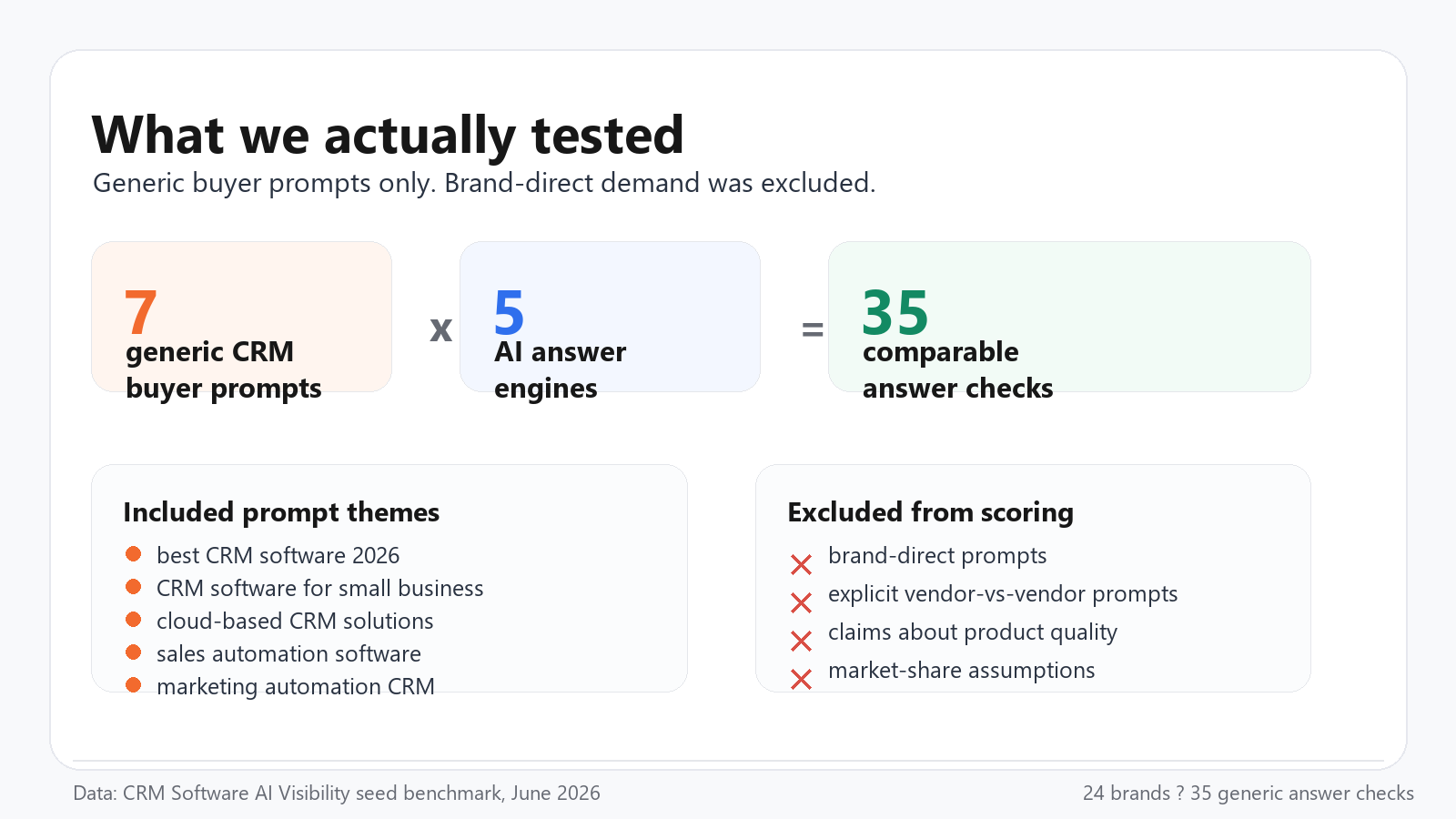
OranGEO measured CRM software visibility using 7 generic buyer prompt themes across 5 AI answer engines: ChatGPT, DeepSeek, Gemini, Grok, and Perplexity.
The included prompt themes were:
- CRM software comparison
- Best CRM software 2026
- Top customer relationship management tools
- Cloud-based CRM solutions
- CRM software for small business
- Sales automation software
- Marketing automation CRM
Brand-direct prompts were excluded from the public score. For example, "HubSpot CRM reviews" did not count. Explicit vendor comparison prompts such as "HubSpot vs Salesforce CRM" were also excluded.
This matters because brand-direct demand measures a different behavior. If someone already asks for a brand by name, the brand is already in the buyer's head. This benchmark focuses on what happens one step earlier: which CRM brands appear before the buyer knows who to compare.
The public score is answer presence. If a brand appeared in 20 of 35 answer checks, its seed visibility score is 57.1%.
This is a seed release, not a final full-category study. Future versions should expand the prompt set, separate SMB and enterprise use cases, extract citation URLs more deeply, and track movement over time.
How CRM Brands Can Improve AI Visibility
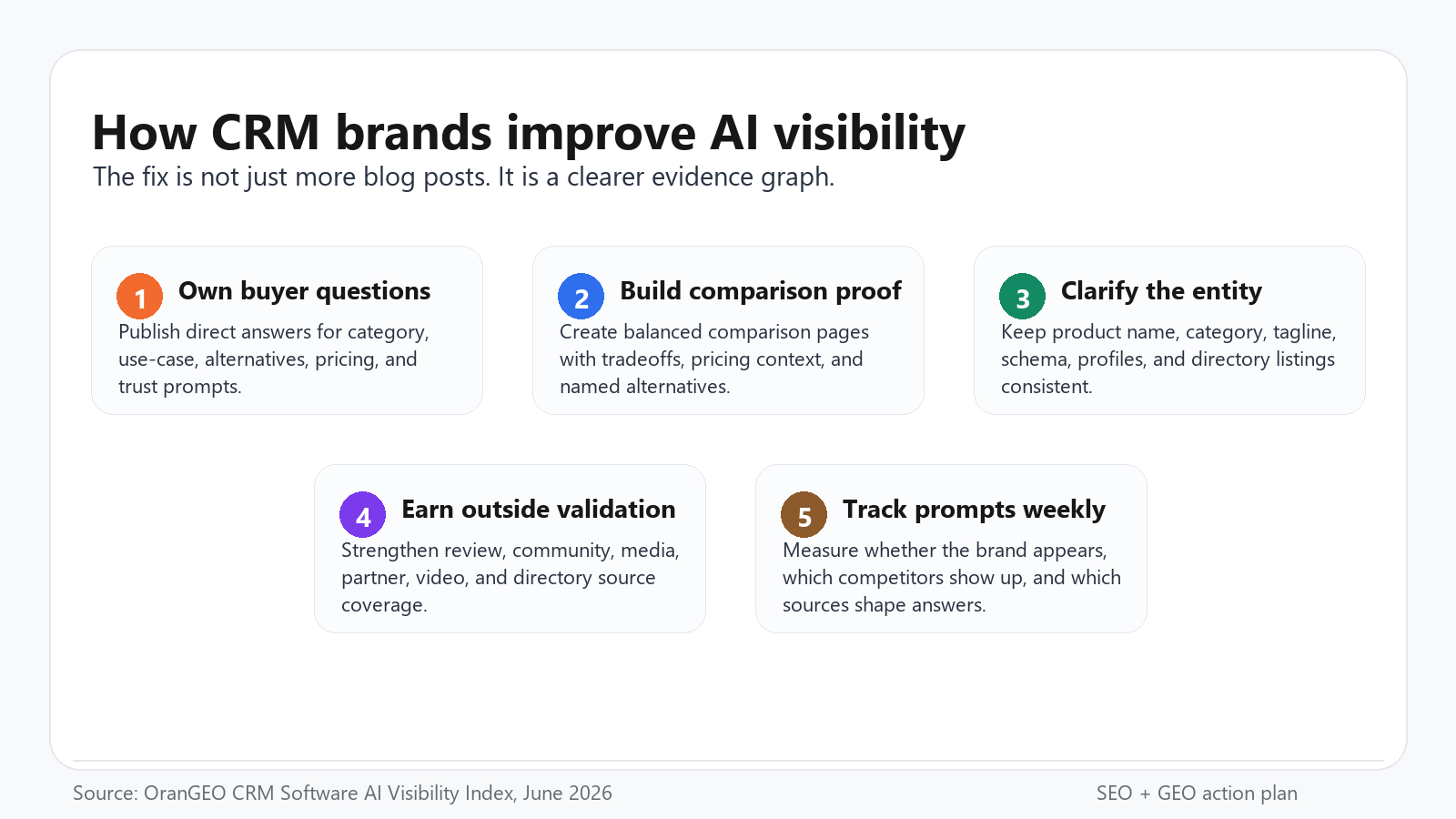
CRM brands with low answer presence should not start by publishing 50 generic SEO posts. The first step is to inspect where AI systems are missing the brand and why.
1. Own the obvious buyer questions
Create direct, crawlable pages for buyer prompts such as:
- Best CRM for small business
- Best CRM for agencies
- CRM with marketing automation
- Salesforce alternatives
- HubSpot alternatives
- Affordable CRM for startups
- CRM for B2B sales teams
The page should answer the question directly, include clear tradeoffs, name relevant alternatives, and explain who the product is and is not for.
2. Build comparison and alternative pages
AI systems frequently synthesize from comparison pages because they contain structured tradeoffs. A strong comparison page should include:
- A short answer at the top
- A balanced comparison table
- Pricing context
- Best-fit and not-best-fit sections
- Integrations and use-case differences
- Links to product docs, pricing, customer proof, and methodology pages
Do not make comparison content fake or one-sided. If the page looks like a thin sales page, it is less useful for both humans and AI systems.
3. Make the brand entity unambiguous
AI systems need consistent signals. Use the same product name, domain, category language, tagline, social profiles, schema, and directory listings across the web.
If your website says "revenue workspace," your review profile says "CRM," your LinkedIn says "sales engagement," and your docs say "relationship intelligence," AI systems have more ambiguity to resolve. Differentiation is good, but category anchors still matter.
4. Publish citation-ready evidence
AI systems prefer content that is easy to quote, summarize, and verify. Useful evidence assets include:
- Methodology pages
- Benchmarks and original research
- Customer case studies
- Pricing and packaging pages
- Integration pages
- Security and compliance pages
- Public documentation
- FAQ pages with direct answers
For this reason, public benchmarks such as the AI Visibility Index can become more than SEO content. They create category context, entity relationships, and comparison evidence that AI systems can parse.
5. Track the same prompt set weekly
Do not rely on one-off manual checks. Track a fixed prompt set across models and time:
- Category discovery prompts
- Use-case prompts
- Alternative prompts
- Competitor comparison prompts
- Pricing prompts
- Trust and review prompts
Log whether your brand appeared, which competitors appeared, where your brand appeared, which sources shaped the answer, and whether sentiment changed. Tools like the AI Visibility Checker and the GEO Prompt Generator can help teams move from random testing to a repeatable workflow.
SEO And GEO Publishing Notes
This article is structured for both search engines and AI answer engines. The same principles apply if your team publishes an industry benchmark, ranking report, or category study.
Recommended on-page SEO structure
- H1: CRM Software AI Visibility Index 2026: Which CRM Brands AI Recommends
- Title tag: CRM Software AI Visibility Index 2026 | OranGEO
- Meta description: OranGEO checked 24 CRM brands across 35 generic AI answer checks. See which CRM tools AI systems remember first, why the shortlist is compressed, and how CRM brands can improve SEO and GEO visibility.
- Canonical URL:
https://geo.oran.cn/blog/crm-software-ai-visibility-index-2026/ - Open Graph image:
/images/blog/crm-software-ai-visibility-index-2026.png - Primary keyword: CRM software AI visibility
- Secondary keywords: CRM Software AI Visibility Index, AI visibility index, AI search visibility, generative engine optimization, GEO for CRM software
Recommended internal links
- Link to the full CRM Software AI Visibility Index.
- Link to the parent AI Visibility Index.
- Link to the AI Visibility Readiness checklist.
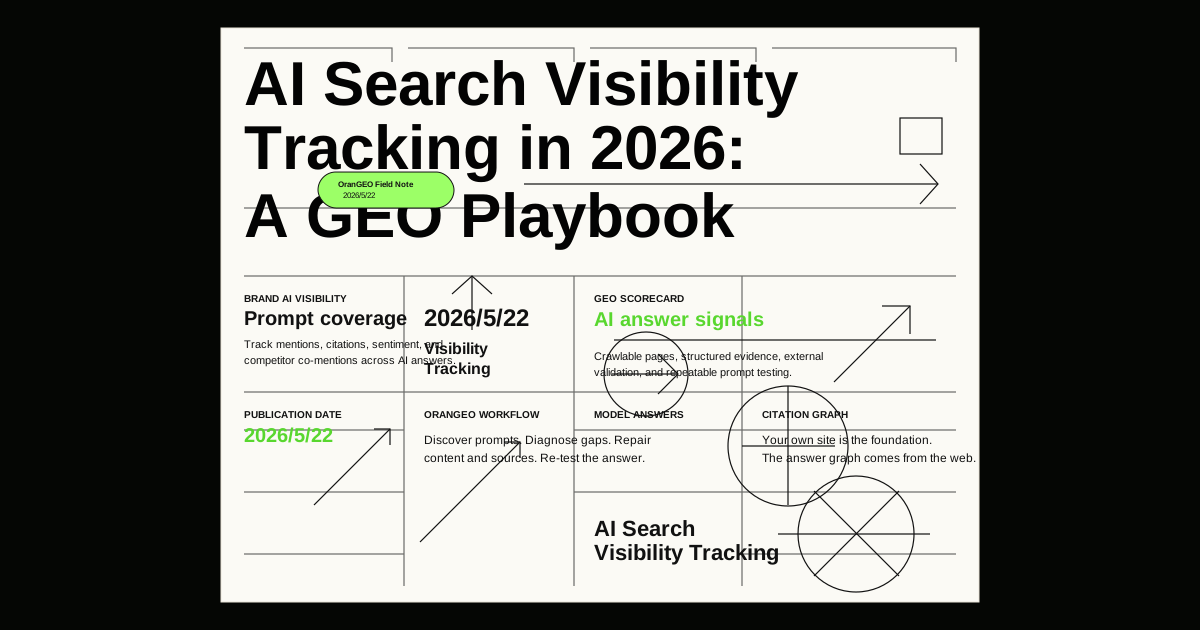
- Link to the broader AI Search Visibility Tracking playbook.
- Link to the AI Visibility Checker and GEO Prompt Generator.
Recommended external links
- Google's guide to optimizing for generative AI features on Google Search.
- Google's documentation for Article structured data.
- Google's general structured data guidelines.
- The official Schema.org Article type.
Recommended schema
Use Article, BreadcrumbList, and FAQPage schema. The structured data should match visible page content. Do not add FAQ answers or claims to schema that are not present on the page.
Google's structured data guidelines note that structured data should represent the visible page content, should not be misleading, and does not guarantee a rich result even when implemented correctly. Treat schema as a clarity layer, not a shortcut.
FAQ
What is CRM software AI visibility?
CRM software AI visibility measures whether a CRM brand appears when AI answer engines respond to generic CRM buyer questions. It is different from SEO ranking because it measures brand presence inside generated answers, not only page position in search results.
Which CRM brands had the highest AI visibility in this benchmark?
HubSpot, Salesforce, Zoho CRM, Pipedrive, and Monday CRM had the highest answer presence in OranGEO's seed CRM Software AI Visibility Index. HubSpot appeared in all 35 checks, while Salesforce appeared in 34.
Does a low AI visibility score mean a CRM product is bad?
No. A low score in this benchmark does not measure product quality, customer satisfaction, or market share. It means the brand appeared less often in generic AI buying answers during this seed run.
Why do some CRM brands appear more often in AI answers?
CRM brands appear more often when AI systems can verify them across clear official pages, third-party comparisons, review sites, community discussions, videos, directories, and consistent entity signals. Repeated public evidence increases recommendation confidence.
How can a CRM brand improve GEO visibility?
A CRM brand can improve GEO visibility by clarifying its category language, publishing comparison and use-case pages, improving crawlability and schema, earning credible third-party mentions, and tracking a fixed set of buyer prompts across AI answer engines.
Is GEO replacing SEO?
No. GEO builds on SEO. Crawlable pages, useful content, internal links, canonical URLs, structured data, and technical clarity still matter. GEO adds a measurement layer for AI-generated answers, citations, competitor mentions, and source influence.
The Bottom Line
The CRM market is crowded, but AI answers do not treat it like a directory. They compress the category into a small shortlist. In this seed benchmark, HubSpot, Salesforce, Zoho CRM, Pipedrive, and Monday CRM dominated generic CRM recommendation prompts, while many recognized brands appeared much less often.
For CRM marketers, the lesson is not to chase a vanity score. The lesson is to build an evidence graph that AI systems can understand and verify.
That starts with clear pages, useful comparisons, specific proof, third-party validation, and repeatable prompt tracking.
OranGEO helps teams measure this answer layer: which prompts mention the brand, which competitors appear instead, and which sources shape the recommendation. To see the full public ranking, visit the CRM Software AI Visibility Index. To measure your own brand, run a scan in OranGEO.