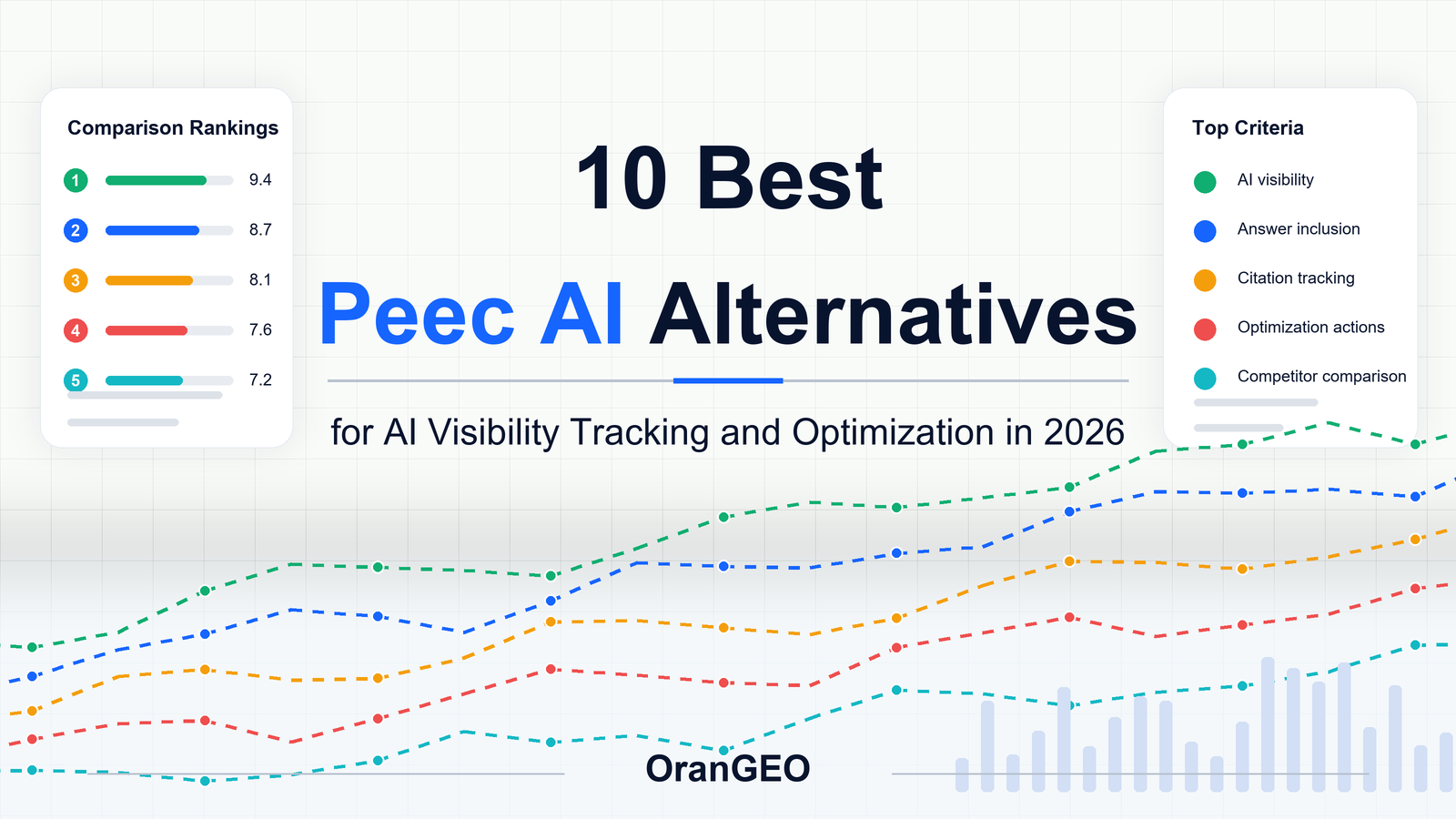
If you are looking for Peec AI alternatives, the issue is probably not that Peec AI is a bad product. The real question is more specific: how should your team measure, explain, and improve the way your brand appears inside AI-generated answers?
Peec AI is an AI search analytics platform for marketing teams. It helps teams track brand visibility, benchmark competitors, and understand what sources AI systems cite across platforms such as ChatGPT, Perplexity, Gemini, and other AI search experiences.
That is useful. But teams do not all need the same AI visibility workflow. Some need a fast diagnostic brief. Some need enterprise dashboards. Some need agency reporting. Some need technical fixes. Some need a content workflow that tells them exactly what to publish next.
This guide compares the best Peec AI alternatives in 2026 and explains when each one makes sense.
Quick verdict
If you want a fast AI visibility audit and a client-ready action brief, start with OranGEO. If you need enterprise AI search intelligence, compare Profound, Brandlight, AthenaHQ, and Scrunch. If you need long-term prompt monitoring, compare OtterlyAI, LLM Pulse, ZipTie, Semrush AI Visibility Toolkit, and Ahrefs Brand Radar.
| Tool | Best for | Main strength |
|---|---|---|
| OranGEO | Brands that need fast diagnosis and next actions | AI visibility audit, competitor reasons, action brief |
| Profound | Enterprise brands and mature growth teams | AI search intelligence, share of voice, source analysis |
| OtterlyAI | SEO teams and agencies | AI search monitoring, brand mentions, competitor tracking |
| Scrunch | Enterprise sites and AI-agent readiness | AI search visibility plus Agent Experience Platform |
| LLM Pulse | Teams connecting visibility to traffic and revenue | Model monitoring, AI referrals, crawler signals |
| ZipTie | Technical SEO and content teams | ChatGPT, Perplexity, and AI Overviews tracking |
| Semrush AI Visibility Toolkit | Existing Semrush users | SEO and AI visibility in one workflow |
| AthenaHQ | Teams building an AEO/GEO operating system | Monitoring, hallucination detection, content recommendations |
| Brandlight | Large enterprise brands | AI visibility OS, technical health, content, partnerships |
| Ahrefs Brand Radar | SEO teams doing large-scale AI visibility research | Large prompt database and brand research |
Why look for a Peec AI alternative?
Peec AI is useful when you already know that AI search matters and want to track how your brand appears across AI platforms. Its public positioning focuses on AI search analytics, competitor benchmarking, and visibility insights for marketing teams.
But a Peec AI alternative may be a better fit if you need one of these workflows:
- A first-time AI visibility audit instead of a long-term monitoring setup
- A simple executive brief instead of a dense analytics dashboard
- Prompt-level explanations for why AI recommends competitors
- Actionable content recommendations, not only visibility charts
- AI crawler, citation, and technical accessibility diagnostics
- Enterprise governance across multiple brands, teams, markets, or regions
In other words, the best Peec AI alternative depends on the job you need the product to do.
How we selected these Peec AI alternatives
This list uses six practical criteria:
- AI platform coverage: ChatGPT, Perplexity, Gemini, Google AI Overviews / AI Mode, Claude, Copilot, and other answer engines.
- Brand diagnosis: whether the tool shows if your brand is mentioned, recommended, cited, or ignored.
- Source analysis: whether it shows which webpages, third-party sources, or communities shape AI answers.
- Actionability: whether it turns gaps into FAQ pages, comparison pages, customer proof, technical fixes, or third-party citation work.
- Reporting experience: whether the output is useful for executives, agencies, clients, or internal SEO teams.
- Team fit: whether the product is better for startups, agencies, SaaS teams, enterprises, or technical SEO teams.
1. OranGEO
OranGEO is the best Peec AI alternative for teams that need to understand the problem quickly before committing to a complex monitoring setup.
Instead of starting with a large dashboard, OranGEO simulates real buyer questions across major AI systems and turns the results into an AI visibility diagnosis. The brief shows whether AI found your brand, whether it recommended you, which competitors were preferred, what sources AI trusted, and what you should fix first.
The practical difference is the output. OranGEO is not just asking, “Did your brand appear?” It is asking, “Why did AI choose this brand, and what content or proof would make your brand easier to recommend?”
Best for:
- First-time AI visibility audits
- Agencies that need a client-readable diagnosis
- Brands that want to turn AI search gaps into content tasks
- Teams that need multilingual AI visibility questions
May not be the best fit for:
- Enterprise BI teams that need deep API integrations
- Teams that only want large-scale historical trend databases
Why choose it:
Choose OranGEO if the main job is to explain the AI visibility problem and identify the next action, not just monitor another metric.
2. Profound
Profound is one of the strongest enterprise options in AI search visibility. Its public positioning focuses on helping brands understand and improve their presence in AI-generated answers, including AI visibility, source citations, brand sentiment, and content AEO.
Profound is a good fit for teams that treat AI search as a long-term strategic channel. It is more enterprise-oriented than many lightweight trackers and is useful when leadership wants visibility, share of voice, source analysis, and competitive context.
Best for:
- Enterprise brands
- Mature SEO, content, PR, and growth teams
- Teams tracking AI search share of voice over time
- Companies with budget for executive-level reporting
May not be the best fit for:
- Small teams that only need one audit
- Users who want a very lightweight setup
Why choose it:
Choose Profound if Peec AI feels too lightweight and you need a more enterprise-grade AI search intelligence platform.
3. OtterlyAI
OtterlyAI is an AI search monitoring platform that tracks brand mentions, website citations, and competitor visibility across platforms such as ChatGPT, Perplexity, Google AI Overviews, and AI Mode.
OtterlyAI feels close to a traditional SEO rank-tracking workflow translated into AI search. You define prompts, run them across AI engines, and monitor how brand mentions, citations, and competitors change over time.
Best for:
- SEO teams
- Agencies
- Weekly or monthly AI visibility reporting
- Teams that already know which prompts they want to track
May not be the best fit for:
- Teams without a prompt universe yet
- Users who need a quick executive diagnosis before ongoing tracking
Why choose it:
Choose OtterlyAI if you want to track AI prompts the way SEO teams track keyword rankings.
4. Scrunch
Scrunch combines AI search visibility monitoring with a more technical idea: making websites easier for AI agents to parse. Its Agent Experience Platform creates lightweight, machine-readable versions of web content for AI systems.
That makes Scrunch different from pure monitoring tools. It is not only about seeing whether you show up. It also focuses on the structure and accessibility of the content AI agents encounter.
Best for:
- Enterprise websites
- Multi-brand or multi-region teams
- Companies that care about AI-agent website access
- Teams that need SOC 2, RBAC, API, and enterprise deployment features
May not be the best fit for:
- Small teams with limited budgets
- Brands that only need a single-page GEO content recommendation
Why choose it:
Choose Scrunch if your problem is not just visibility tracking, but whether your site is readable and useful for AI agents.
5. LLM Pulse
LLM Pulse positions itself as an all-in-one AI search platform. It tracks brands across ChatGPT, Gemini, Perplexity, Google AI, and other models, then connects visibility with share of voice, traffic, conversions, and AI crawler signals.
This matters because AI visibility eventually has to connect to business impact. Teams will ask: did AI search send traffic? Did it influence leads? Did crawlers access our content? LLM Pulse is useful when the measurement conversation moves beyond mentions.
Best for:
- Teams connecting AI visibility to traffic and conversions
- Marketers who want AI crawler and referral signals
- Teams that want continuous monitoring
May not be the best fit for:
- Users who only need a quick brand diagnosis
- Teams not yet ready for attribution workflows
Why choose it:
Choose LLM Pulse if your team wants to connect AI visibility with traffic, crawler behavior, and commercial outcomes.
6. ZipTie
ZipTie focuses on tracking visibility in ChatGPT, Perplexity, and Google AI Overviews, then giving practical insights to improve online presence.
ZipTie is especially interesting for technical SEO and content teams because it fits a familiar workflow: monitor, diagnose, optimize, and retest. It is not only a brand sentiment dashboard; it is closer to a practical optimization platform for AI search.
Best for:
- Technical SEO teams
- Content teams
- Teams monitoring Google AI Overviews
- Users who want practical optimization suggestions
May not be the best fit for:
- Enterprise teams needing broad brand governance
- Teams focused mainly on PR or social reputation
Why choose it:
Choose ZipTie if your AI visibility workflow is closely tied to technical SEO and content optimization.
7. Semrush AI Visibility Toolkit
Semrush AI Visibility Toolkit is a natural Peec AI alternative for teams that already work inside Semrush. It shows how brands appear in AI-generated answers and helps marketers measure a new layer of visibility beyond traditional search.
The advantage is workflow consolidation. Many SEO teams already use Semrush for keyword research, competitor analysis, audits, and reporting. Adding AI visibility inside that environment may be easier than buying a separate point solution.
Best for:
- Existing Semrush users
- SEO teams that want AI visibility inside their current toolkit
- Teams that want traditional SEO and AI visibility in one place
May not be the best fit for:
- Teams that want an AI-search-native workflow
- Agencies that need a highly visual client diagnosis
Why choose it:
Choose Semrush AI Visibility Toolkit if your SEO team already lives in Semrush and wants to add AI visibility without changing systems.
8. AthenaHQ
AthenaHQ describes itself as a command center for AEO and GEO. It combines cross-platform monitoring, competitive intelligence, hallucination detection, and content recommendations.
AthenaHQ is a fit for teams that want a more complete AI SEO operating system rather than a simple tracker. It is especially relevant if your team needs to know where you are winning, where competitors are gaining visibility, and what should be fixed next.
Best for:
- SaaS and commercial teams
- Brands that need competitor monitoring and content recommendations
- Teams treating GEO as an ongoing process
May not be the best fit for:
- Small teams testing AI visibility for the first time
- Users who only need simple mention tracking
Why choose it:
Choose AthenaHQ if you want more prescriptive recommendations than a basic prompt tracker provides.
9. Brandlight
Brandlight is built for enterprise AI visibility. Its public product areas include Visibility & Insights, Technical Health, Content, Agentic Commerce, Partnerships, and Attribution.
Brandlight is not just an AI search tracker. It is closer to an enterprise operating system for how large brands appear across AI search, AI agents, content surfaces, and partner ecosystems.
Best for:
- Fortune 500 and large enterprise brands
- Teams managing visibility across multiple departments
- Companies that need technical, content, partnership, and attribution layers
May not be the best fit for:
- Early-stage startups
- Small teams that need a simple audit report
Why choose it:
Choose Brandlight if AI visibility is already a CMO-level enterprise initiative.
10. Ahrefs Brand Radar
Ahrefs Brand Radar brings Ahrefs’ data strength into AI visibility. It emphasizes large-scale AI visibility research powered by search-backed prompts, with support for analyzing brands, products, regions, and people.
This is valuable for SEO teams that want market-level visibility research rather than only a set of manually configured prompts. Ahrefs also connects AI visibility thinking with its broader SEO, content, and search data ecosystem.
Best for:
- SEO professionals
- Content strategy teams
- Teams researching many brands or topics
- Existing Ahrefs users
May not be the best fit for:
- Agencies that need a simple client-facing diagnosis
- Teams that want prompt-by-prompt explanations of why AI chose a competitor
Why choose it:
Choose Ahrefs Brand Radar if you care about large-scale AI visibility research and want it connected to traditional SEO data.
Peec AI vs OranGEO: which should you choose?
If your team already has a strong prompt monitoring workflow in Peec AI and reviews visibility trends every week, you may not need to switch.
But OranGEO is a stronger fit when you need:
- A first AI visibility audit
- A clear brief for a client, founder, or CMO
- An explanation of why AI recommends competitors
- A practical list of content, proof, citation, and technical fixes
- A multilingual workflow for different target markets
The simple distinction is this: Peec AI is closer to continuous AI search analytics. OranGEO is closer to AI visibility diagnosis and action planning.
How to choose the right Peec AI alternative
Use this decision path:
If you have never audited AI visibility before
Start with OranGEO.
You need to understand your current position before you build a long-term monitoring workflow.
If you already know which prompts matter
Compare Peec AI, OtterlyAI, LLM Pulse, and ZipTie.
These tools are better for ongoing prompt tracking and visibility trends.
If you are an enterprise brand
Compare Profound, Brandlight, Scrunch, and AthenaHQ.
These options are better for governance, multi-market reporting, and cross-functional AI search strategy.
If you already use a major SEO suite
Compare Semrush AI Visibility Toolkit and Ahrefs Brand Radar.
They are strongest when AI visibility needs to sit beside keyword, content, backlink, and competitor research.
Frequently asked questions
What is Peec AI?
Peec AI is an AI search analytics platform for marketing teams. It helps teams track how their brand appears across AI search systems, monitor competitors, and understand which sources AI platforms cite when generating answers.
What is the best Peec AI alternative?
The best Peec AI alternative depends on your workflow. OranGEO is best for fast diagnosis and action briefs. Profound and Brandlight are strong enterprise options. OtterlyAI, LLM Pulse, and ZipTie are good for ongoing prompt monitoring. Semrush and Ahrefs are useful for teams already working inside SEO suites.
How is OranGEO different from Peec AI?
Peec AI is more focused on AI search analytics and ongoing monitoring. OranGEO is more focused on AI visibility diagnosis: it simulates real buyer questions, checks whether AI finds and recommends your brand, explains competitor preference, and turns the result into content and citation actions.
What metrics should an AI visibility tool track?
A useful AI visibility tool should track brand mentions, recommendation rate, competitor share, citation sources, sentiment, prompt-level gaps, and changes after content fixes. Mention count alone is not enough because AI can mention your brand but still recommend a competitor.
Are Peec AI alternatives useful for agencies?
Yes. Agencies should choose based on deliverable type. If you need a client-readable audit, OranGEO is a strong fit. If you need monthly prompt monitoring, OtterlyAI, LLM Pulse, ZipTie, or Semrush AI Visibility Toolkit may fit better.
Final recommendation
Do not choose a Peec AI alternative by counting features. Choose based on the decision you need the tool to support.
If you need long-term monitoring, compare Peec AI with OtterlyAI, LLM Pulse, and ZipTie.
If you need enterprise AI search intelligence, compare Profound, Brandlight, Scrunch, and AthenaHQ.
If you need to quickly understand why AI does or does not recommend your brand, start with OranGEO.
The core question is simple: when a buyer asks AI what to choose, does the tool help you understand why AI picked someone else and what you should fix next?