AI search visibility tracking is the practice of measuring whether a brand appears, gets cited, and is described accurately inside AI-generated answers across platforms like ChatGPT, Google AI Mode, Google AI Overviews, Perplexity, Gemini, Copilot, and Grok. In 2026, this has become a core GEO workflow because buyers are no longer only comparing blue links. They are asking AI systems which vendor to trust, which product to shortlist, and which source explains a topic best.
The hot topic in GEO right now is no longer "what is generative engine optimization?" The more urgent question is operational: how do you know if AI is recommending you, your competitor, or nobody at all? That is where OranGEO fits. Instead of treating AI search as a vague brand-awareness channel, OranGEO turns model answers into measurable signals: share of model, citation sources, sentiment, competitor co-mentions, and content gaps.
TL;DR: What Changed in AI Search Visibility
- Google says AI search still depends on SEO fundamentals. Its official guide says generative AI features rely on core Search ranking and quality systems, including retrieval-augmented generation and query fan-out.
- GEO research has moved from theory to measurement. The Princeton-led GEO paper presented at KDD 2024 reported that optimization methods can improve visibility in generative engine responses by up to 40%.
- Third-party trust signals matter. A Seer Interactive study of 804,491 AI responses found that review profiles correlate with significantly higher AI citation rates across platforms and funnel stages.
- AI visibility is multi-channel. Ahrefs' Brand Radar documentation now frames AI visibility across AI answers, SEO, YouTube, Reddit, and TikTok, which confirms that model answers are influenced by more than your own website.
- Brands need a new dashboard. Rankings still matter, but they are no longer enough. The new question is whether AI systems mention your brand when the buyer asks for a recommendation.
Why Traditional Rank Tracking Is Not Enough
Traditional SEO measurement is built around a simple chain: keyword, ranking position, impression, click, landing page, conversion. AI search breaks that chain. As we explained in Marketing Visibility in the AI Search Era, a user can ask "best AI SEO tool for tracking ChatGPT mentions" and receive a synthesized shortlist without clicking any result. If your brand is absent from that answer, your page-one ranking may not matter at the decision moment.
Google's own documentation makes the technical side clear: AI Overviews and AI Mode are grounded in Search systems, and eligible pages need to be crawlable, indexable, and useful. Our guide to AI content indexing covers the same foundation from a GEO perspective. But that is only one surface. ChatGPT, Perplexity, Copilot, Gemini, and Grok each have different retrieval behavior, citation habits, and source preferences. A brand can be visible in Google organic search yet invisible in ChatGPT recommendations.
This is why the metric needs to change from "where do we rank?" to "when AI answers the buyer's question, do we appear, how are we framed, and what source is shaping that answer?"
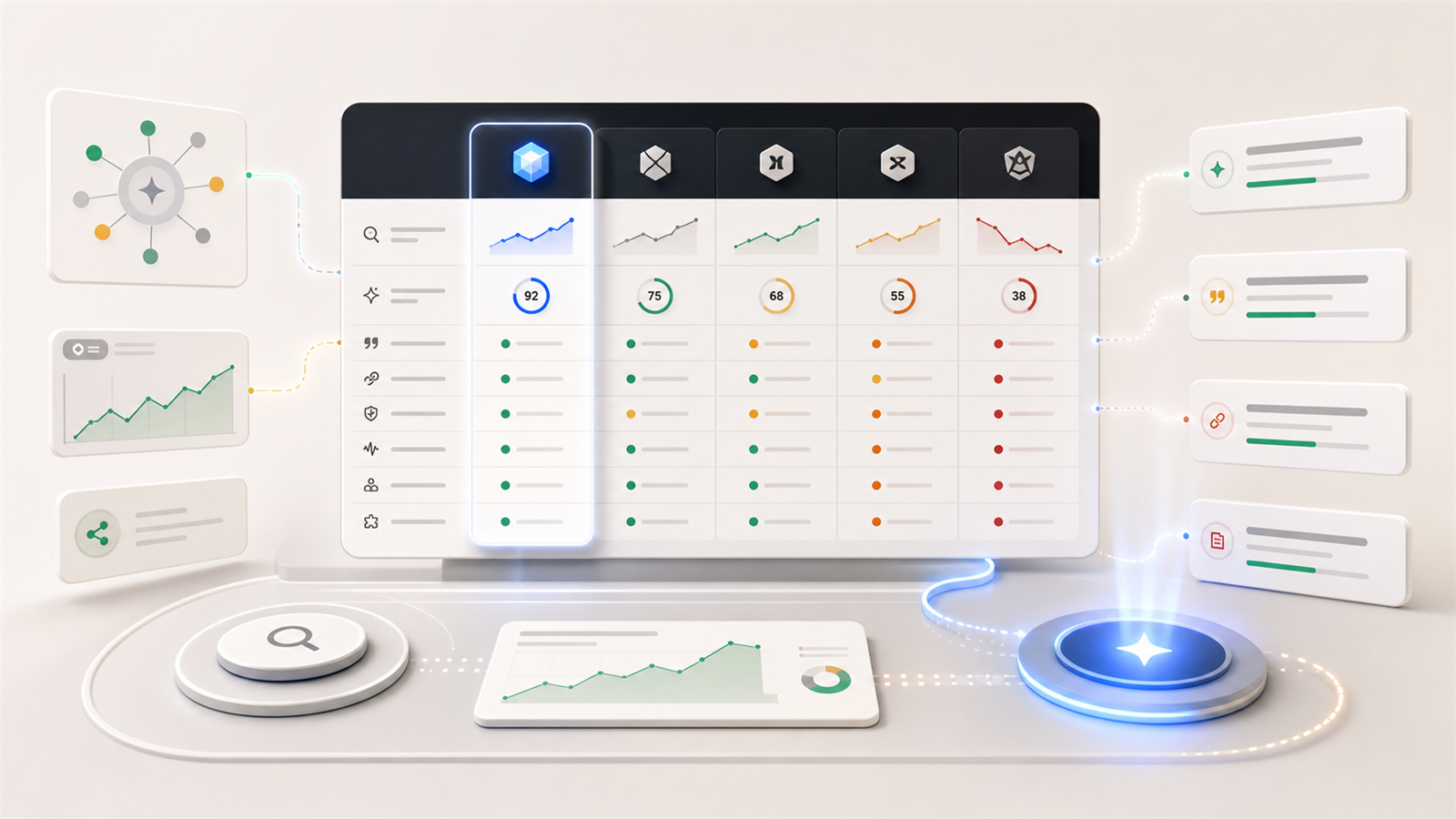
The 5 Metrics That Matter for AI Search Visibility
| Metric | What it measures | Why it matters |
|---|---|---|
| AI Share of Voice | How often your brand appears across a tracked prompt set compared with competitors. | Shows whether your brand is part of the recommendation set. |
| Citation Ownership | Which pages or third-party sources AI cites when mentioning your category. | Reveals the sources shaping the model's answer. |
| Sentiment | Whether AI describes the brand positively, neutrally, or negatively. | Visibility without trust can still hurt conversion. |
| Competitor Co-Mentions | Whether competitors appear in answers about your brand or your category. | Identifies threats in high-intent recommendation prompts. |
| Content Gap | Which facts, comparisons, proof points, or structured pages AI cannot find. | Turns monitoring into an action plan. |
OranGEO's core advantage is that it treats these metrics as a system. A single AI answer is anecdotal. A repeated pattern across prompts, models, categories, and competitors becomes a visibility signal you can act on.
What the Latest Research Says
The strongest recent pattern is that AI engines reward clarity, evidence, and external validation. This does not mean brands should write robotic "AI-first" content. It means content needs to be easy to parse, easy to verify, and consistent across sources.
The Google Search Central guide to generative AI features says the same foundation still applies: create helpful, reliable, non-commodity content, keep pages crawlable, and avoid scaled content created only to manipulate rankings or AI responses.
The Princeton-led GEO paper formalized generative engine optimization as a measurable discipline and reported visibility gains of up to 40% in generative engine responses. The practical lesson for marketers is not "stuff more keywords." It is to add credible evidence, clear structure, specific numbers, and source-backed statements.
The newest commercial research points in the same direction. Seer Interactive's 804,491-response study found that review profiles correlate with higher AI citation rates, especially near the decision stage. That matters because AI does not only answer informational queries. It increasingly answers "should I trust this brand?" and "which vendor should I choose?"
Meanwhile, Ahrefs' Brand Radar documentation shows how fast the tooling category is moving. AI visibility is now tracked across six AI platforms and adjacent influence channels such as YouTube, Reddit, and TikTok. That confirms a key GEO reality: your own site is necessary, but the answer graph is built from the wider web.
The OranGEO GEO Workflow
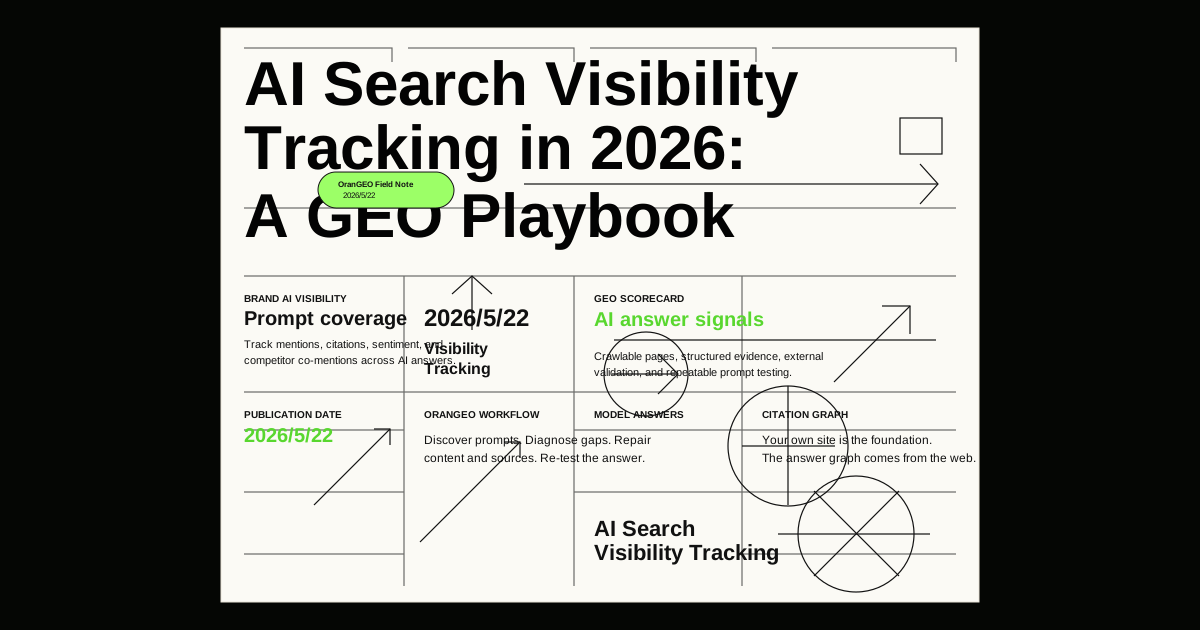
A practical AI visibility program should run in four loops: discover, diagnose, repair, and measure. Most teams skip straight to content production. That is why they publish more pages without knowing whether AI systems understood anything new.
1. Discover the prompts that matter
Start with prompts that map to real buyer behavior:
- Best [category] tools for [use case]
- [Brand] vs [competitor]
- Is [brand] trustworthy?
- What are the pros and cons of [brand]?
- Which [category] platform should a small team choose?
OranGEO helps teams build repeatable prompt sets instead of manually testing random questions. The public OranGEO documentation explains how to connect brand audits, source analysis, and content actions. This matters because AI answers vary across platforms and over time. You need a controlled monitoring baseline before you can evaluate improvement.
2. Diagnose why the brand is missing
When AI fails to mention a brand, the cause usually falls into one of five buckets:
- Indexability failure: Important pages are not crawlable, canonical, or included in a clean sitemap.
- Entity ambiguity: AI cannot clearly connect the brand to a category, use case, or competitor set.
- Proof gap: The site makes claims but lacks data, reviews, case studies, or third-party validation.
- Source gap: Competitors are cited from review platforms, media, Reddit, YouTube, or comparison pages where your brand is absent.
- Content format gap: The answer exists on your site, but it is buried in generic copy rather than a clear paragraph, table, FAQ, or comparison block.
3. Repair the content and source graph
Once the gap is known, GEO work becomes concrete. You can publish a comparison page, improve a pricing page, add product facts, update schema, claim a review profile, or build a category guide that answers the exact prompt family. The best repairs are small but specific. Do not rewrite the entire site when the problem is one missing trust signal or one unclear category association.
4. Measure whether AI behavior changed
The final step is re-testing across models and prompt groups. Did the brand appear more often? Did sentiment improve? Did the cited source change from a competitor comparison page to your own guide? Did a review profile become part of the answer? These are the questions OranGEO is built to answer.
What to Publish Next If You Want AI to Recommend You
Based on current AI search behavior, the highest-leverage content types are:
- Comparison pages: Clear, balanced pages for "[your brand] vs [competitor]" and "best [category] tools" prompts.
- Use-case pages: Pages that connect product value to a concrete buyer situation.
- Evidence pages: Case studies, benchmarks, customer proof, methodology pages, and original research.
- Trust pages: Review summaries, security pages, policies, pricing transparency, and public documentation.
- AI-readable resources: Clean sitemaps, llms.txt, structured data, and pages with direct answer sections.
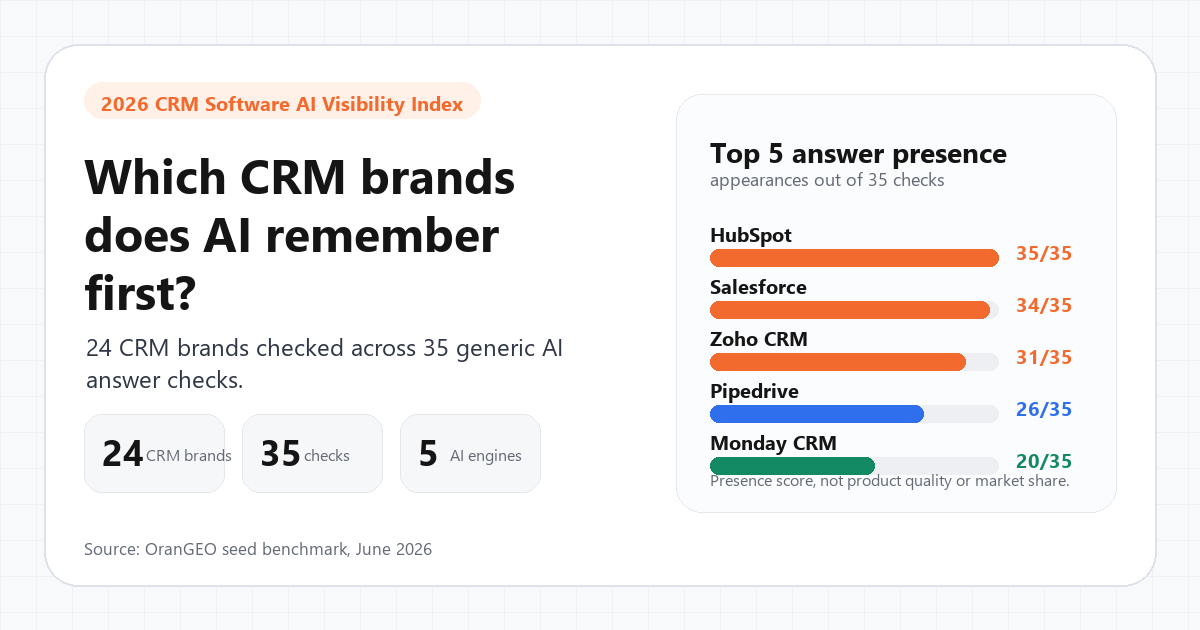
This is why OranGEO maintains an AI Visibility Index. Public index pages create entity relationships, category context, and comparative evidence. They do not just target search traffic. They help AI systems understand the category landscape.
A Practical 30-Day AI Visibility Plan
Week 1: Build the measurement baseline
Pick 30 to 50 prompts across awareness, evaluation, intent, and trust. Track your brand, top competitors, citations, and sentiment across at least three AI platforms.
Week 2: Fix technical and entity clarity
Check sitemap health, canonical tags, robots rules, structured data, brand naming consistency, and crawlable content. If AI cannot access or disambiguate your information, content strategy will not save you.
Week 3: Publish one high-intent asset
Choose the prompt family where the buyer is closest to a decision. Publish a guide, comparison page, or evidence page that gives AI a source worth citing. Include direct answers, specific facts, tables, and links to supporting sources.
Week 4: Re-test and expand source presence
Run the same prompt set again. If the answer still cites competitors, inspect those sources. Are they review sites, listicles, Reddit discussions, YouTube videos, or media roundups? The next task is not always another blog post. Sometimes it is third-party validation.
FAQ
Is AI search visibility tracking the same as rank tracking?
No. Rank tracking measures where a page appears in search results. AI search visibility tracking measures whether a brand appears inside generated answers, which sources are cited, how the brand is described, and which competitors are recommended instead.
Does GEO replace SEO?
No. GEO builds on SEO. Crawlable pages, clean canonicals, useful content, structured data, and strong source authority still matter. GEO adds a measurement layer for AI-generated answers and model citation behavior.
What should a brand fix first if AI does not mention it?
Start with indexability, entity clarity, and proof. Make sure the site can be crawled, the brand is clearly tied to its category and use cases, and third-party sources can validate the claims the brand wants AI systems to repeat.
The Bottom Line
AI search visibility in 2026 is not a replacement for SEO. It is a measurement layer on top of SEO, content, reputation, and third-party source presence. Google still needs crawlable, useful pages. ChatGPT and Perplexity still need sources they can trust. Buyers still need proof before they act.
The brands that win will not be the ones publishing the most AI-written posts. They will be the ones that know which prompts matter, which sources influence the answer, and which content gaps prevent AI from recommending them.
OranGEO helps teams make that shift: from guessing whether AI understands their brand to measuring exactly where they appear, why they are cited, and what to fix next.